Speak to an Expert Today!
714-639-3326
sales@decotechgroup.com
Headquarters
1040 Segovia Circle
Placentia, CA 92870

714-639-3326
sales@decotechgroup.com
1040 Segovia Circle
Placentia, CA 92870
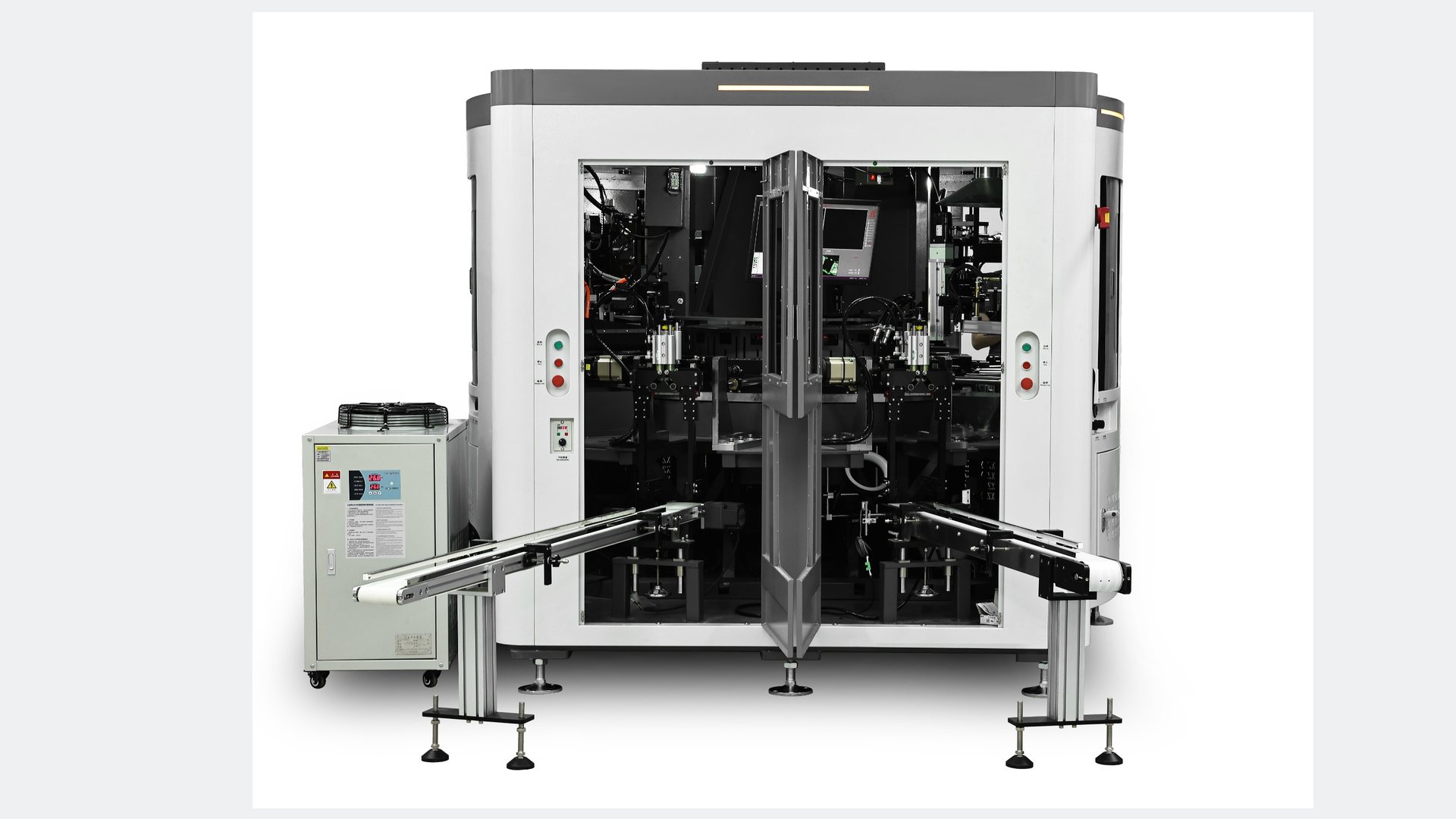
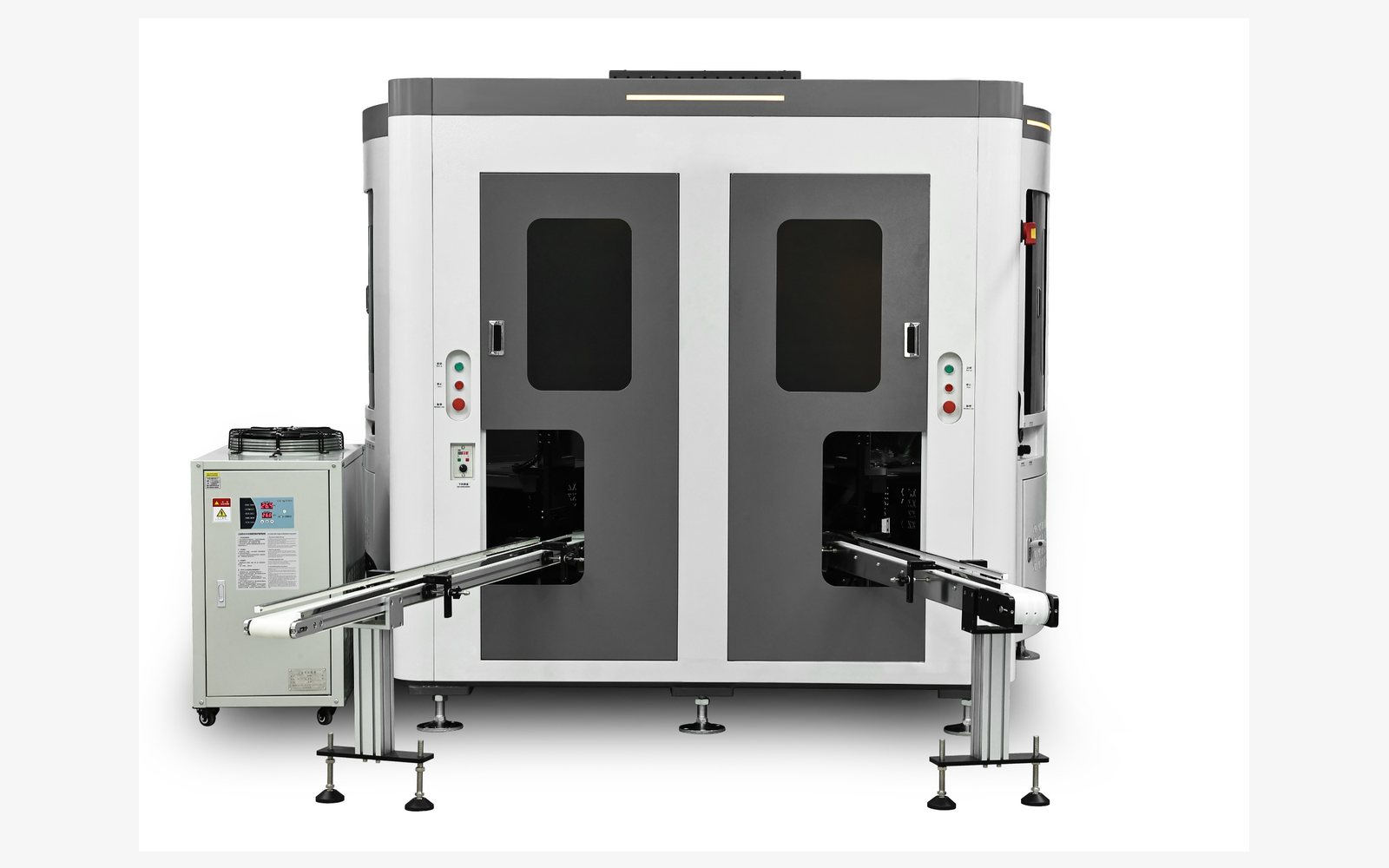
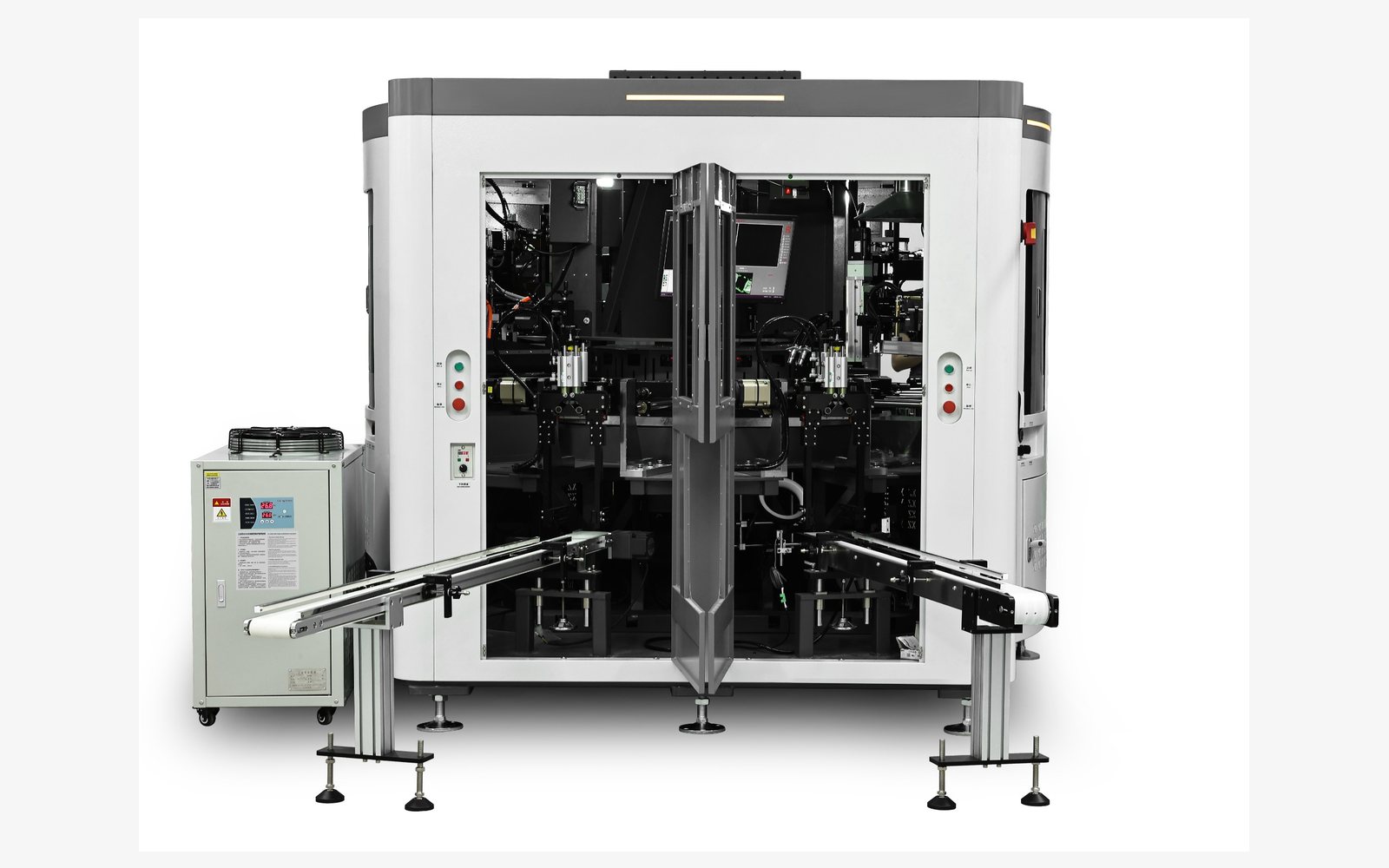
The automated, servo-driven DT-CNC Series is available in 2-, 3-, 4-, 5- and 6-color configurations for high-speed automated UV screen printing on round, oval, square and flat-sided bottles and containers. Each system combines automatic loading, surface preparation, CCD camera vision registration, LED UV curing and automatic unloading on one rotary platform, with optional hot stamping in place of one screen-printing station.
The print is established at this station. The screen, squeegee and container move together through the stroke, while the DT-CNC controls each motion independently to match the package being decorated.
This close-up shows the container held in matched tooling beneath the print station as the screen travels across the part.
The motion profile is programmed for the container. Round parts can rotate at a constant rate; oval, square and other flat-sided parts require controlled changes in speed and position through the print stroke.
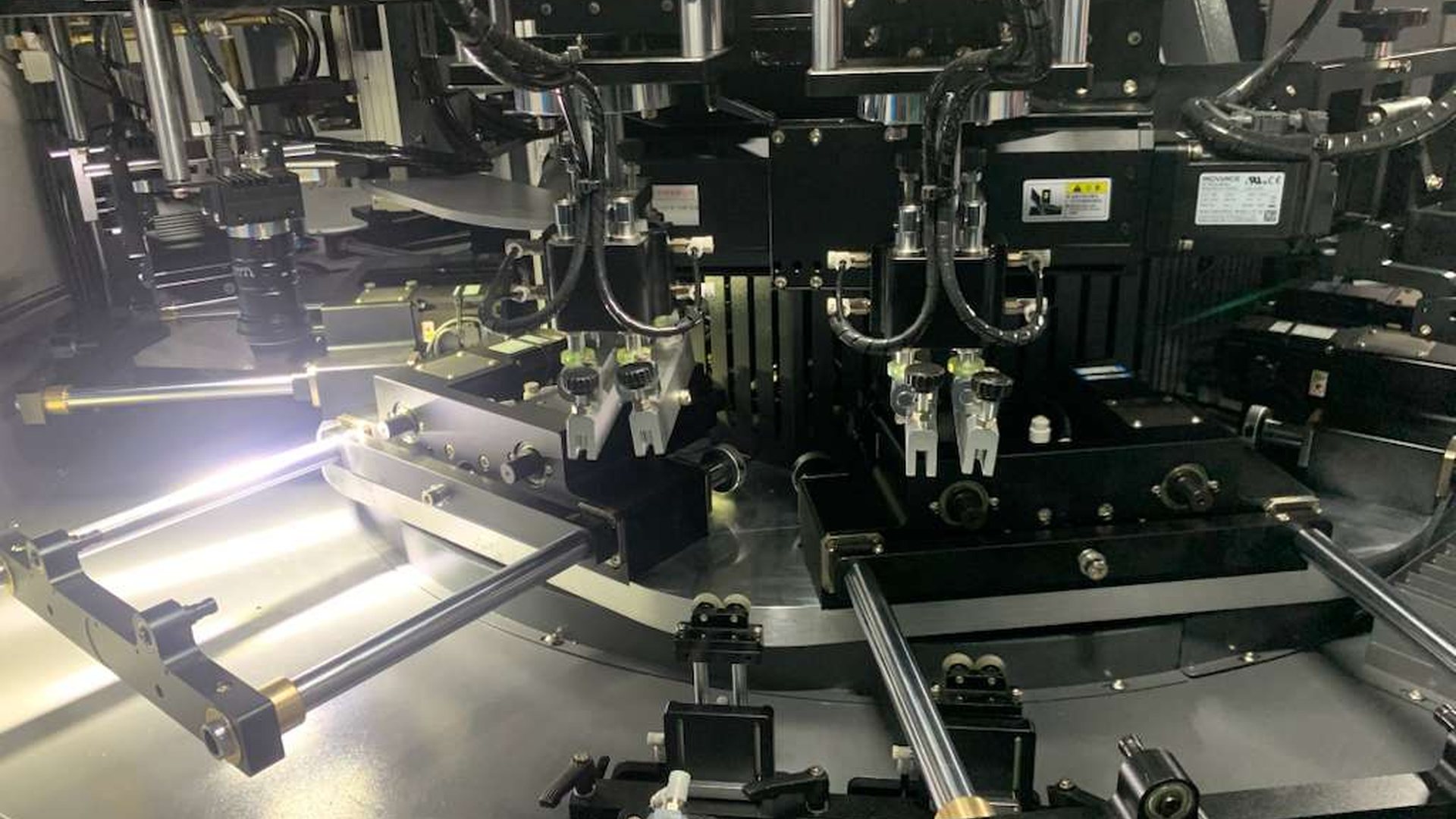
The servo rotary table moves every fixture to the next process station.
Each fixture has its own servo drive and follows the profile saved for the product.
Screen travel, squeegee travel, and print-head height are set independently at each print station.
Optional body and bottom cameras can locate a seam, opening, thread, notch, or registration mark before the first color.
The station sequence is selected around the application. A configured line can include automatic loading, part detection, anti-static cleaning, flame treatment, CCD orientation, screen printing, LED UV curing, inspection and automatic unloading.
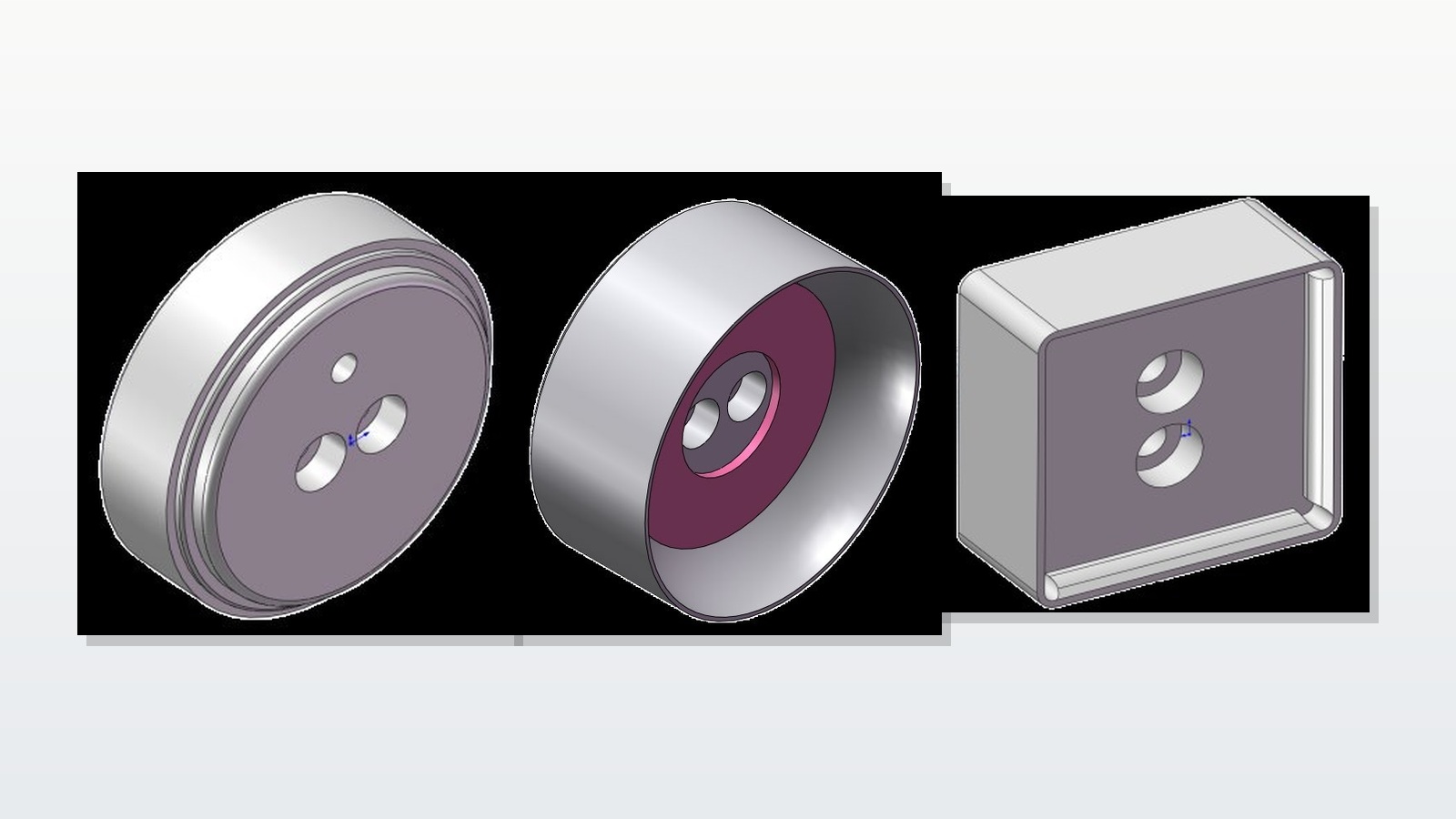
Each container is supported by application-specific tooling and fixture hardware. The tooling locates the part, controls rotation and keeps it under control as the servo-driven rotary table indexes through treatment, printing, curing and inspection stations.
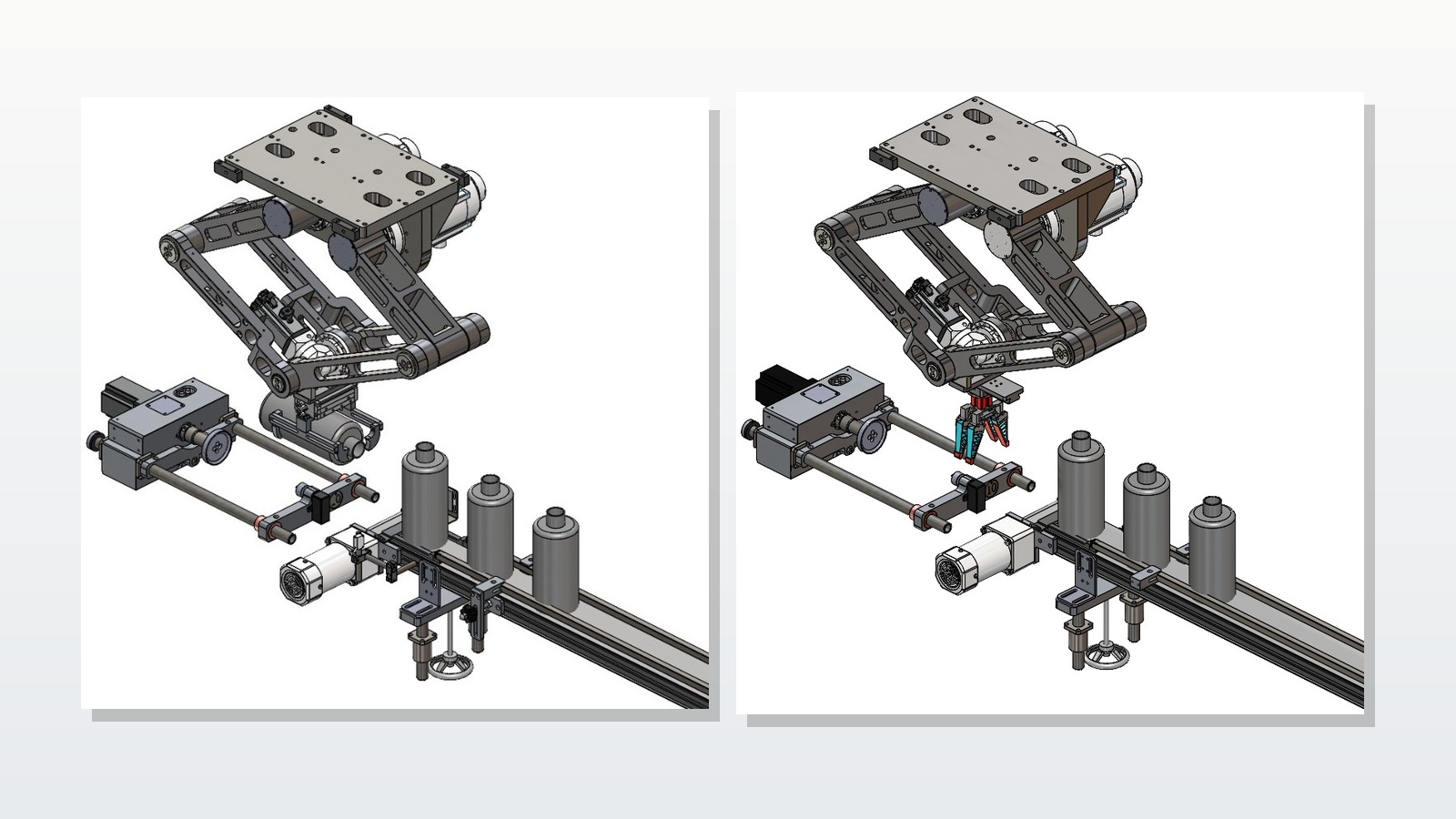
Containers move from the infeed conveyor into the support cradle and onto the fixture. The enclosed line is engineered with product-specific loading, part detection and automatic transfer to the outfeed conveyor.
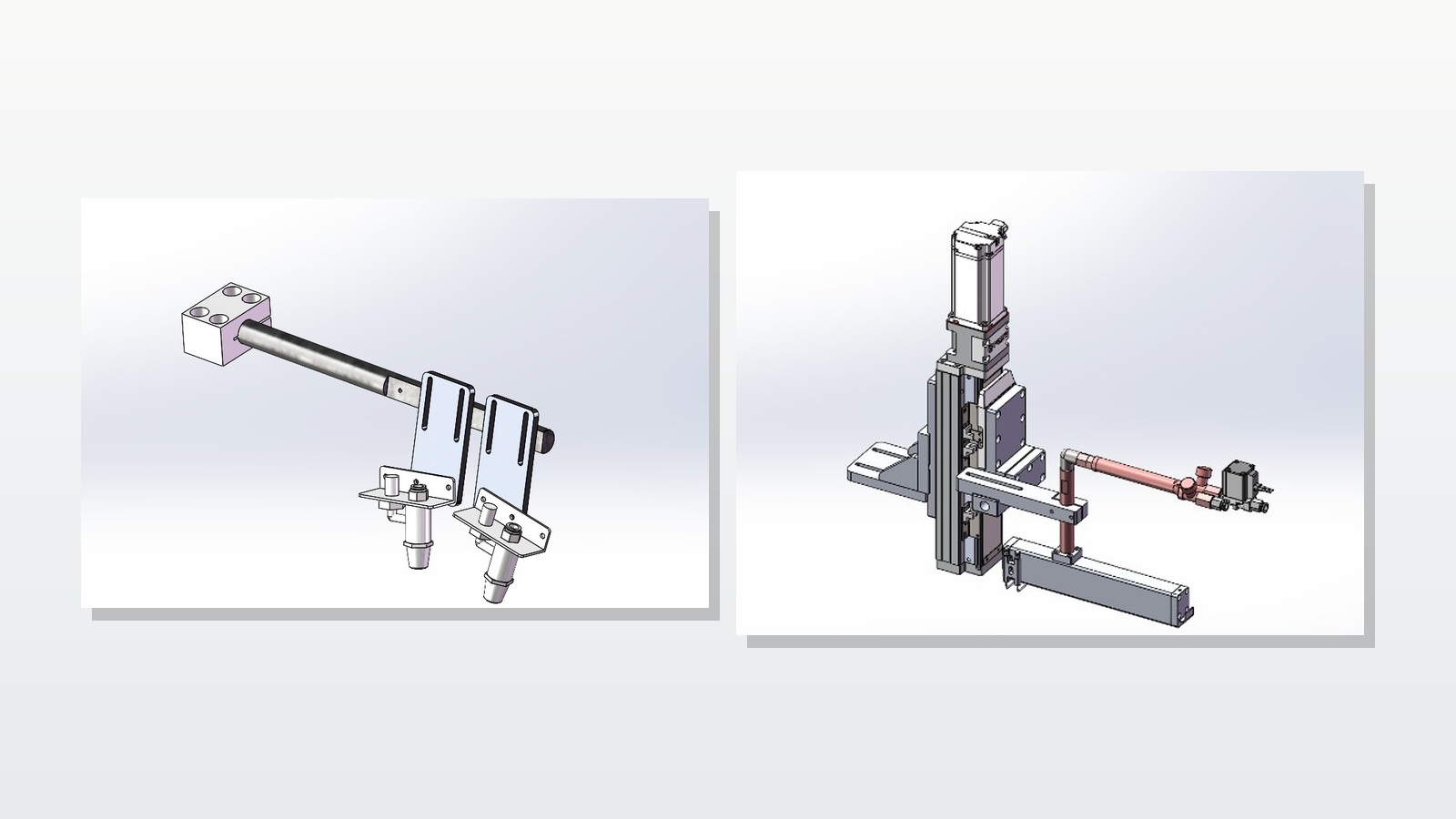
An ionizing bar neutralizes static while air nozzles remove loose dust. Flame treatment can be added for low-surface-energy plastics that need higher surface energy before printing.
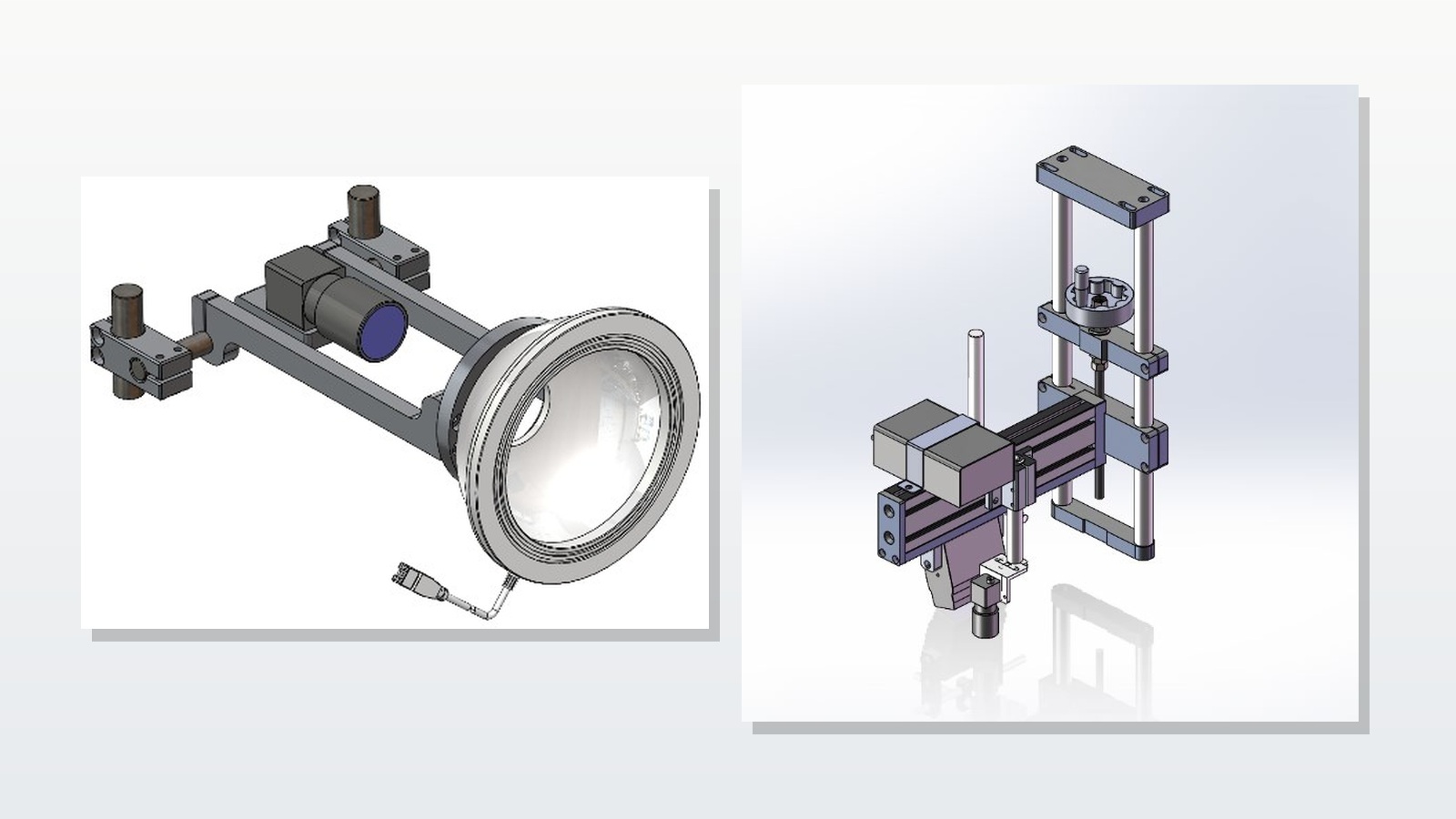
Optional body and bottom cameras can find a mold seam, opening, thread, notch or registration mark and apply angular correction before the first color.
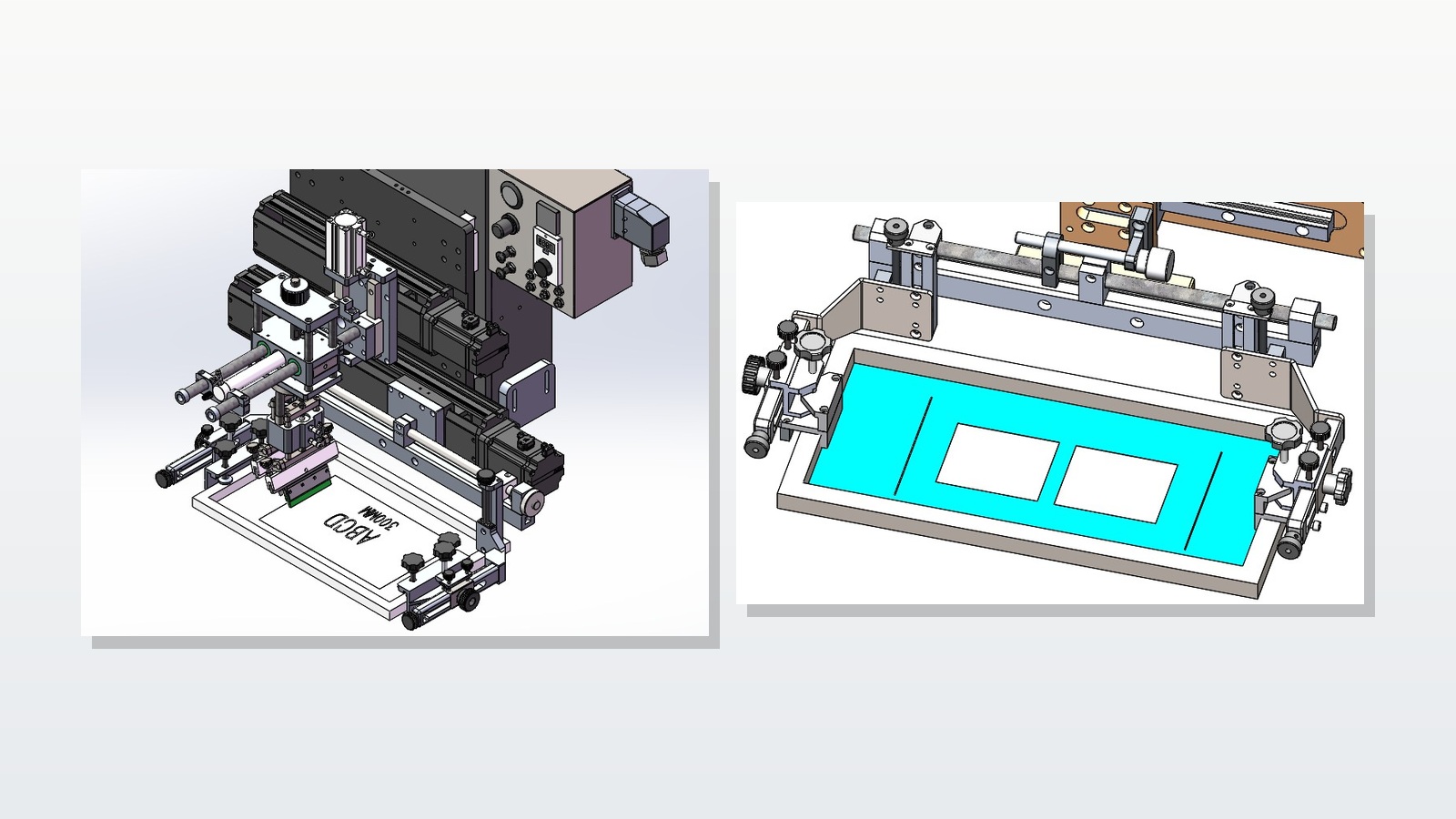
The screen frame, fixture rotation and print-head tracking are programmed together. Start and end positions, off-contact, squeegee pressure and print-head height are set for the job.
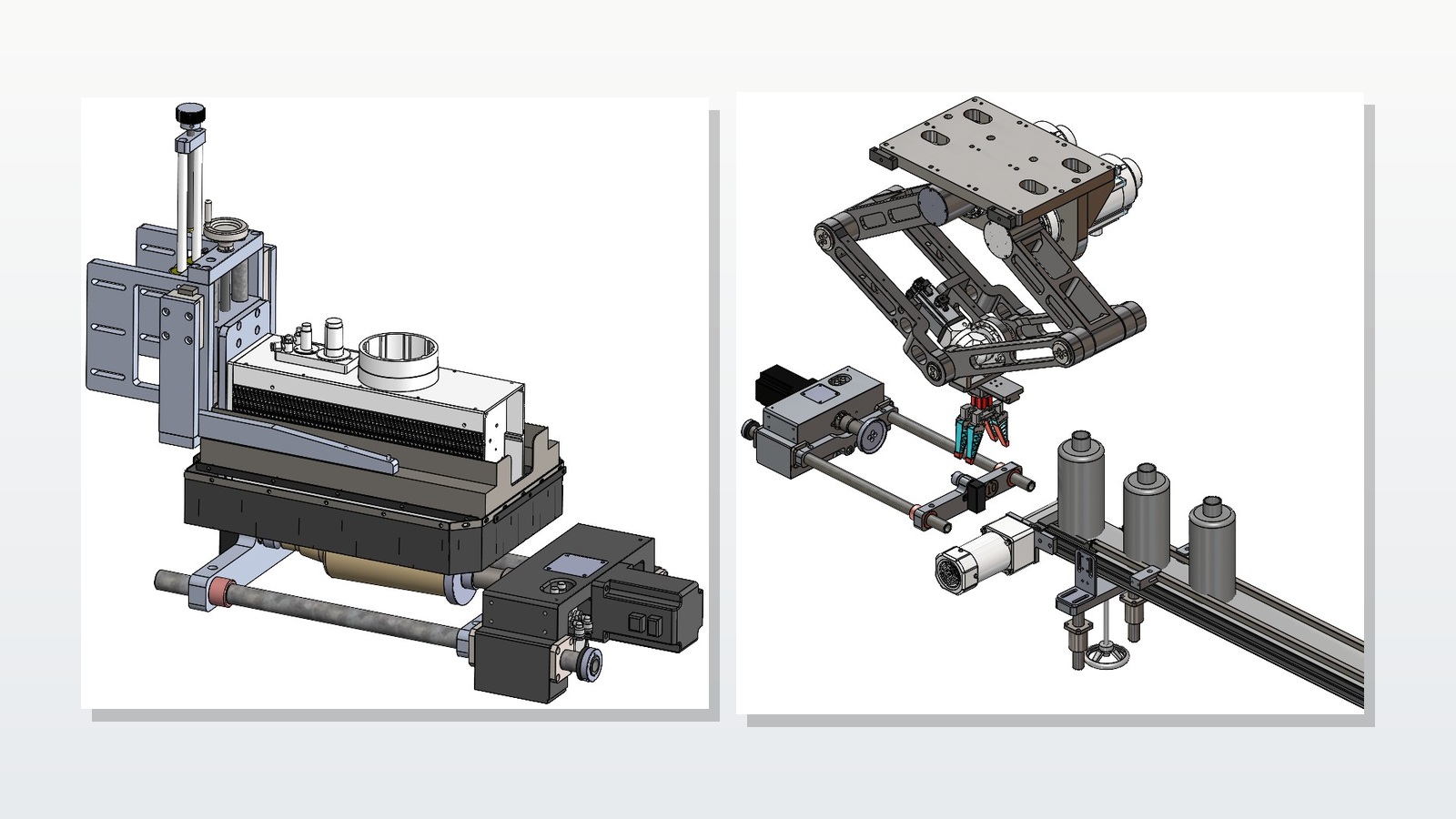
Each color is cured at its assigned UV station. The unloading robot removes the finished part and places it on the outfeed conveyor using product-specific grippers.
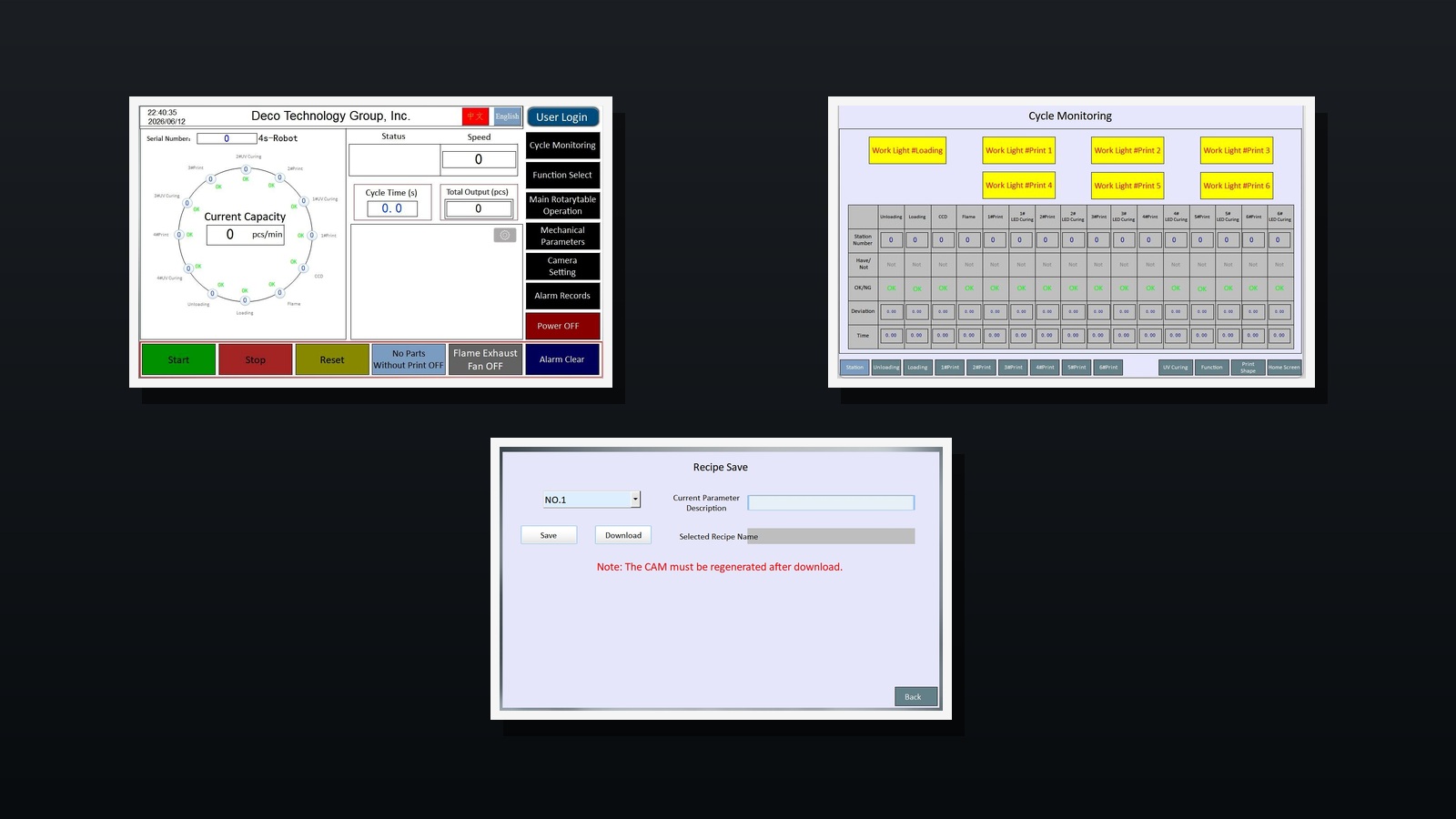
The DT-412CNC recipe system stores up to 50 product parameter groups with the associated graphic and cam data. Operators can also view cycle status, part presence, vision results, station timing, alarm history, servo fault codes and PLC input/output status.
The DT-CNC platform is available in 2-, 3-, 4-, 5- and 6-color configurations. The interactive maps below show representative 4- and 6-color layouts; station count and placement for every system are finalized during application engineering.
These are representative process maps rather than fixed station layouts. Final assignments are confirmed during application engineering.
Watch the full machine cycle from automatic handling through screen printing, curing and finished-part transfer. Additional production videos below show specific applications, vision functions, robotic handling and print configurations.
See how the automated stations work together as one production line, including part movement, printing and downstream handling.
See specific print cycles, container applications, vision inspection and automated part handling on DT-CNC production configurations.
Close production views of rotary indexing, screen travel, squeegee motion and the fixture beneath the print head.
See the DT-CNC platform running different container formats, color counts and multi-part production setups.
See the camera inspection system and three-axis robotic handling used with round and oval containers.
The motion profile changes with the shape. Round containers rotate at a constant radius. Oval, square and other flat-sided containers require programmed speed and position changes so the screen remains matched to the printable surface.
The fixture turns continuously while the screen travels across the artwork.
The servo profile accelerates and decelerates as the contact radius changes through the print stroke.
The motion profile manages each printable face and the transition from one printable face to the next.
The DT-CNC platform is built for automatic direct decoration of cosmetic and personal-care bottles, pharmaceutical and nutraceutical containers, household cleaner bottles, jars, rigid cylindrical industrial products, wine bottles and spirits bottles. Plastic and glass are the most common applications. Selected coated metal or aluminum parts can also be reviewed when the actual product, ink system, pretreatment, foil and tooling are compatible.

Perfume and fragrance bottles, skincare and serum bottles, lotion bottles, cosmetic jars, hair-care packaging and other premium beauty containers.

Shampoo, conditioner, body-wash, hand-soap, deodorant, grooming and other personal-care bottles in round, oval or flat-sided formats.

Medicine bottles, vitamin bottles, supplement containers, topical tubes, healthcare packaging and other rigid packages requiring repeatable registration.
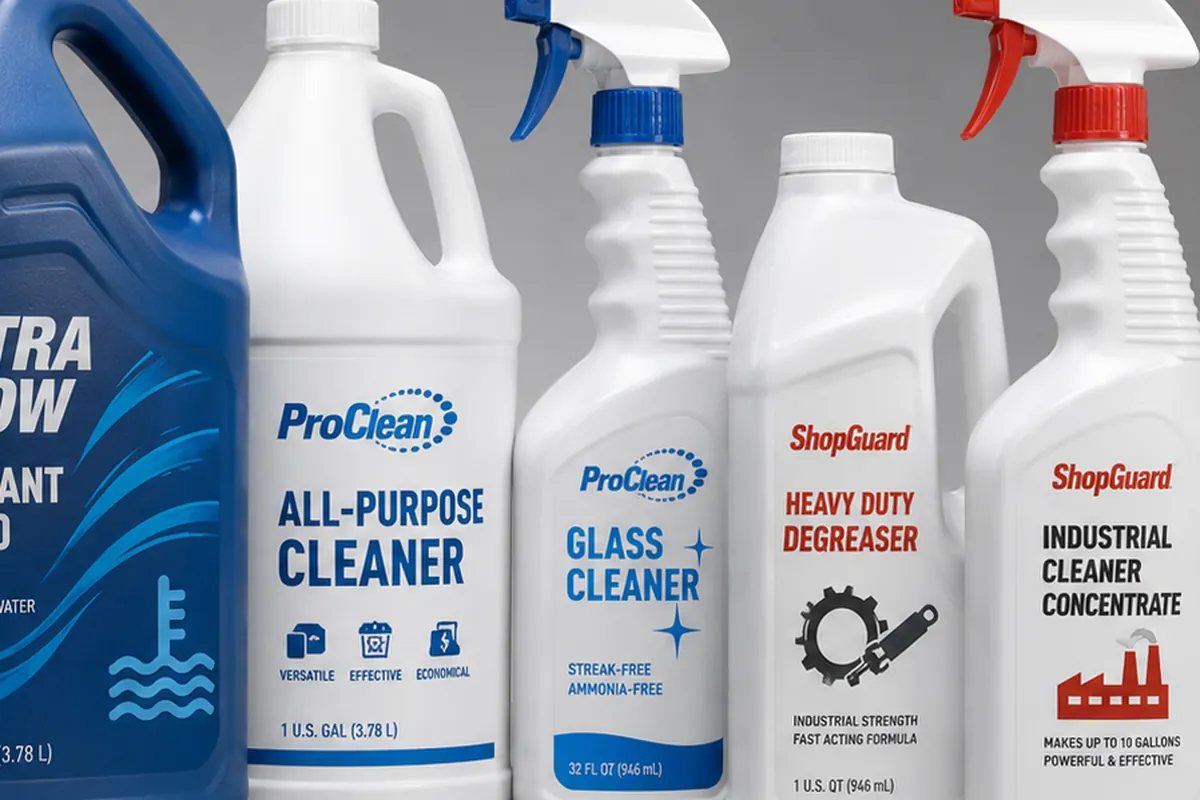
Detergent, disinfectant, glass cleaner, degreaser, laundry, air-care and trigger-spray containers made for retail and institutional markets.
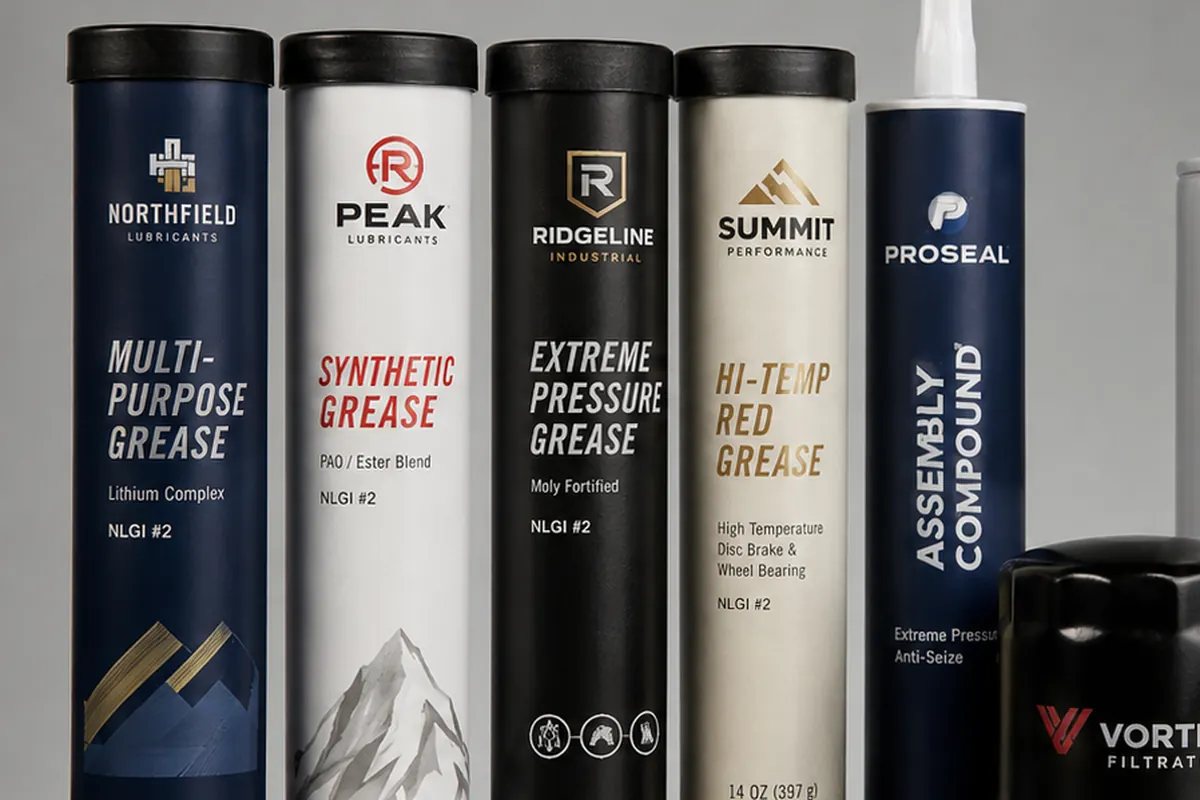
Grease gun cartridges, assembly-compound tubes and similar rigid cylindrical industrial or automotive-related products requiring durable direct decoration.
Decorative glass bottles, luxury product containers, limited-edition packaging and other high-value formats that benefit from opaque ink and foil accents.
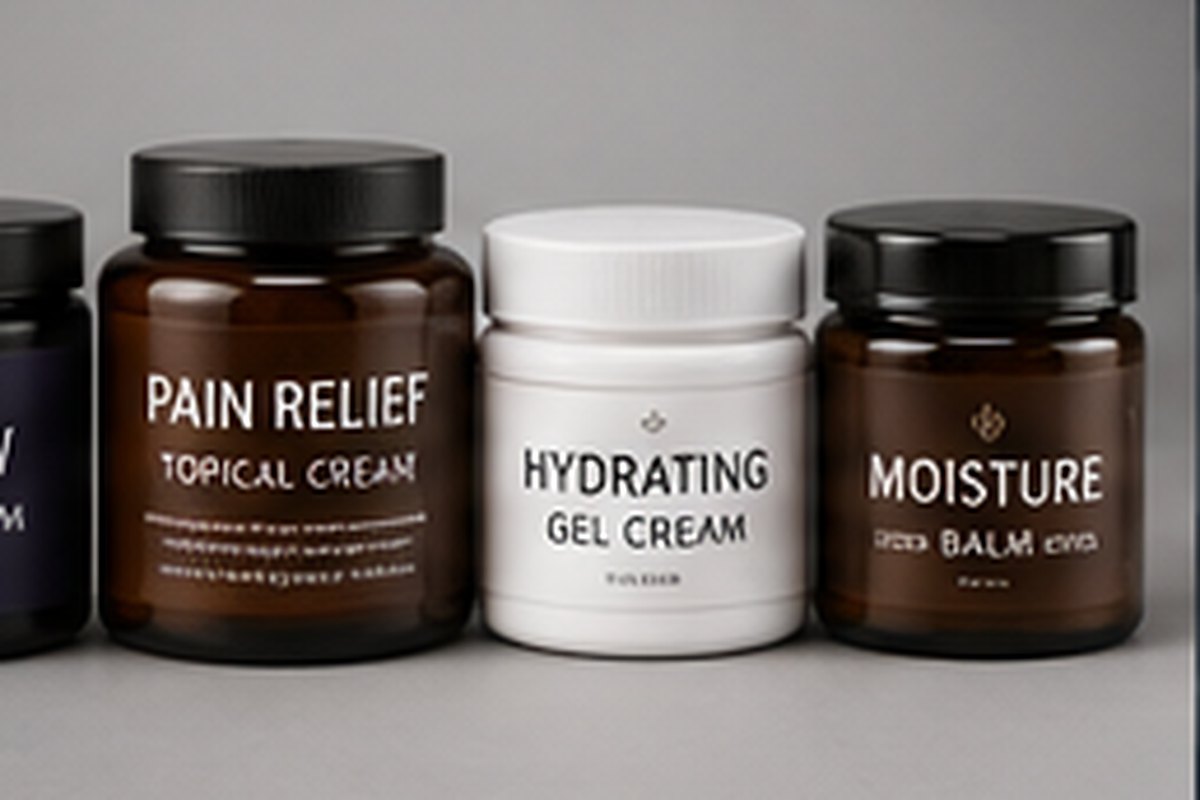
Skincare jars, cream and ointment jars, supplement containers and other rigid cylindrical or shaped packages that can be supported in matched tooling.
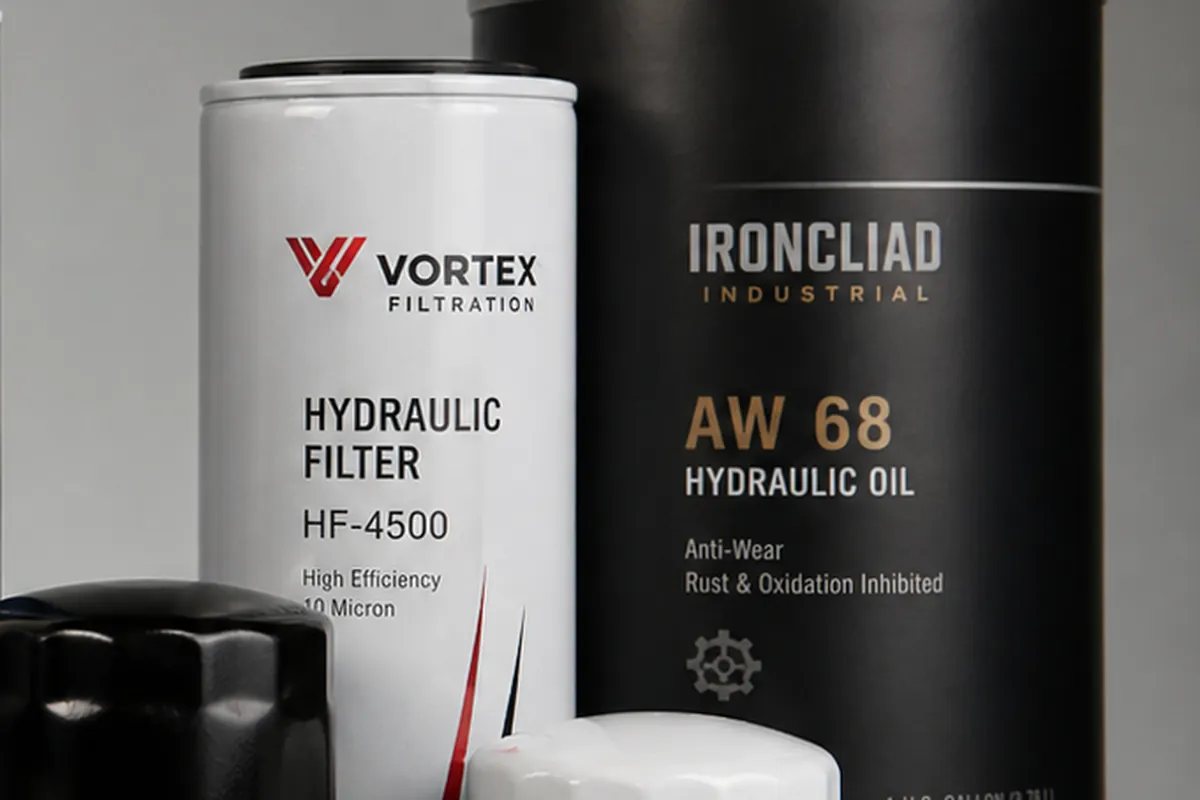
Oil filters, cylindrical housings, sleeves, cartridges and selected molded components that can be loaded, treated, registered and held securely during decoration.

Selected wine bottles, liquor bottles, vodka bottles, whiskey bottles, gin bottles and specialty glass packaging can be decorated with direct screen printing and premium hot-stamped accents.
Ink selection, flame or other pretreatment, UV curing, fixture design and hot-stamp foil must be validated on the production-grade package.
When one screen-printing station is exchanged for the application-specific hot-stamping station, the line can add gold, silver, metallic, holographic or colored foil to approved areas. Typical uses include logos, product names, crests, bands, borders and premium accents on cosmetic, pharmaceutical, personal-care, wine, spirits and luxury packaging.
Common applications include plastic and glass cosmetic bottles, toiletry and personal-care containers, pharmaceutical and nutraceutical products, household cleaning-product bottles, industrial packaging containers, automotive-related grease cartridges, lubricant tubes, oil filters, wine bottles and spirits bottles. Final compatibility depends on part dimensions, material, surface condition, print area, artwork, wall rigidity, production rate and matched tooling.
Hot stamping adds foil decoration with heat and pressure. On the DT-CNC platform, a screen-printing station can be replaced with an application-specific hot-stamping station when the job calls for metallic or specialty foil accents.
The final hot-stamping head, tooling and foil path are engineered around the application. Foil type, temperature, pressure and dwell are confirmed during process testing.
The established 2-color, 4-color and 6-color platforms remain available, with 3-color and 5-color configurations offered for applications that fall between those standard layouts. The interactive comparison below shows the published 4- and 6-color platform data. Optional hot stamping replaces one print station.
| Fixture-position drives | 12 independent Inovance servo drives |
|---|---|
| Container range - round | Ø20–120 mm × H20–300 mm |
| Container range - oval | W20–120 mm × H20–300 mm |
| Container range - square | W20–150 mm × H20–300 mm |
| Published platform speed | Up to 60 parts/min for round containers; 35–50 parts/min for oval or square containers |
| Published registration accuracy | ±0.1–0.3 mm |
| Motion control | Beckhoff controller with servo-controlled screen, squeegee, print-head and fixture axes |
| Rotary platform | GOIZPER servo rotary table |
| Surface preparation | Anti-static dust removal and integrated flame pretreatment; other options are application dependent |
| Visual registration | Optional bottle-body and bottle-bottom CCD vision |
| Production controls | HMI cycle monitoring, alarm history, I/O diagnostics and product recipe storage |
| Optional decoration | Interchangeable hot-stamping head in place of one print station |
| Published speed with hot stamping | Approximately 25–35 parts/min, subject to the container, foil area, tooling and process |
| Published reference utilities | 380V–480V, 3-phase, 50 Hz; 6–8 bar compressed air. Final requirements follow the selected configuration and machine nameplate |
| Optional inspection | Full-color print inspection systems are available for qualified applications |
These published reference specifications preserve the established 2-color, 4-color and 6-color platform data. The 3-color and 5-color configurations are specified around the application. Final utilities, dimensions, weight, station assignments, options, as-built drawings and machine nameplate govern the delivered system.
2-color standard platform
4-color standard platform
6-color standard platform
The 2-color DT-208-CNC (DT-208CNC) and the 3- and 5-color configurations are available for applications that do not require the established 4- or 6-color layouts. Utility requirements, dimensions, machine weight, fixture positions and installed options are confirmed for the selected configuration; final as-built drawings and the machine nameplate take precedence.
Deco Tech provides application review, system integration, installation, operator and maintenance training, documentation, spare-parts coordination, post-sale support and service, and North American technical support.
Send the container drawing or dimensions, artwork, material, annual volume, target rate and physical samples when available.
The fixture set, screens, inks, pretreatment, curing and motion profile are evaluated on the actual package.
Deco Tech installs the system, trains the production team and supports the move from setup into routine operation.
The customer package includes operating and maintenance instructions, HMI and robot setup, preventive-maintenance checklists and as-built electrical documentation. Service and application support are based in California.
The DT-412CNC operating manual separates routine maintenance into daily, monthly and annual tasks. It also calls for maintenance records, recipe backups and inspection of the safety, electrical, pneumatic, UV, vision and motion systems.
Include the container dimensions, material, artwork, number of print colors, annual volume and target rate. Physical samples are required before the final machine configuration is approved.
Common applications include cosmetic and fragrance bottles, personal-care containers, pharmaceutical and supplement bottles, household cleaner bottles, jars, specialty glass bottles, grease cartridges, oil filters, rigid cylindrical components and selected wine and spirits bottles. Every product is reviewed for size, material, surface condition, tooling, pretreatment, curing and target speed.
The DT-CNC platform is available in 2-, 3-, 4-, 5- and 6-color configurations. The exact number of fixture positions, curing units and optional stations is confirmed during application engineering.
Yes. The published DT-CNC range includes round, oval and square containers. Every new package still requires a fixture and process review.
No. CCD visual registration is optional. It is used when the print must align to a seam, molded feature or existing decoration.
The platform supports an interchangeable hot-stamping station in place of one print station. Whether it can be added later should be confirmed when the machine is configured.
No. The published platform maximum is up to 60 parts per minute. The DT-412CNC operating manual lists a 35–55 parts-per-minute reference range for round containers and 35–50 for square or other shapes. Print length, ink, curing, loading, vision and inspection all affect the final rate.
Send container drawings or dimensions, artwork, material, annual volume, target rate and physical samples when available.