Speak to an Expert Today!
714-639-3326
sales@decotechgroup.com
Headquarters
1040 Segovia Circle
Placentia, CA 92870

714-639-3326
sales@decotechgroup.com
1040 Segovia Circle
Placentia, CA 92870
Pad shape, size, height and Shore 00 hardness all affect how the silicone pad picks up the etched image and transfers it onto the part. The goal is simple: choose a pad that rolls cleanly across the full image with the least practical compression and the least distortion.
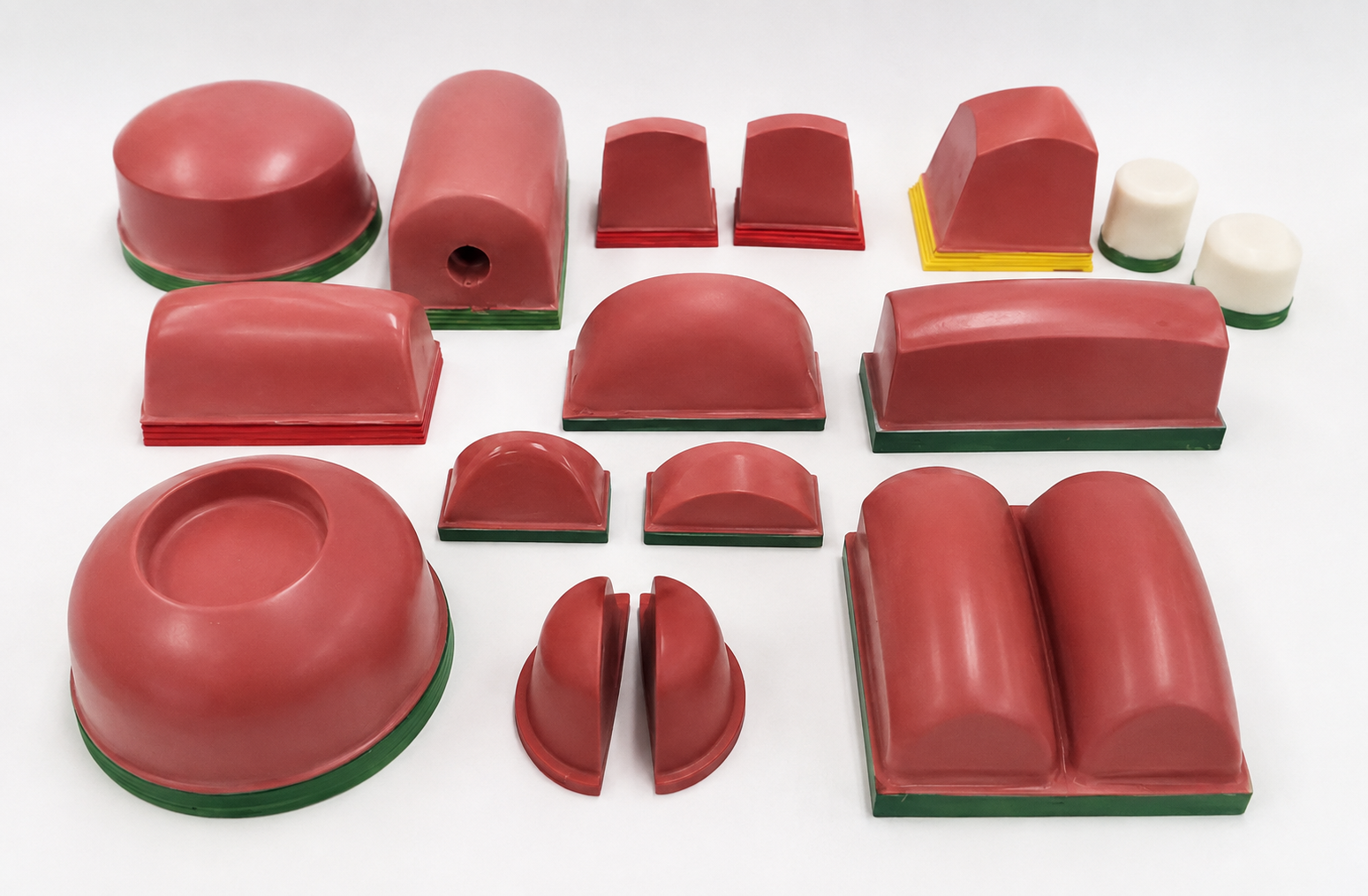
There is rarely only one silicone pad that can print a given part successfully. The best choice is the pad that delivers repeatable ink pickup and transfer while fitting the physical limits of the machine and part.
The profile determines how the silicone compresses and rolls across the cliché and the part.
A larger practical pad generally deforms less and helps keep the transferred image stable.
Taller profiles can provide more rolling action and may reduce the compression force required.
Harder pads provide greater image stability; softer pads provide more conformability.
The printing surface must remain clean and undamaged for reliable ink pickup and release.
Formulation, base style and mounting arrangement should match the production requirement.
Good pad printing depends on controlled rolling action. As the pad compresses onto the cliché and then onto the part, the contact area should move progressively outward instead of trapping air under a broad flat surface.
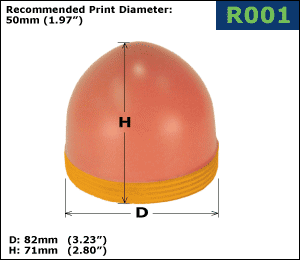
Balanced, concentric compression. A strong starting point for many compact graphics and general applications.
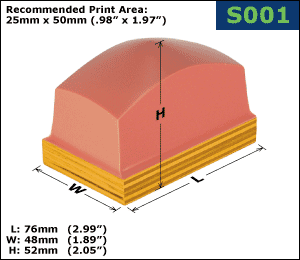
Useful where machine clearance favors a square footprint while still providing controlled compression.
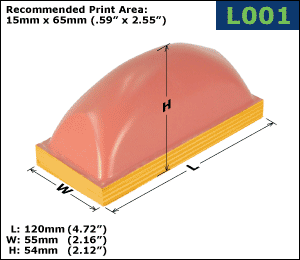
Longer pad geometry for linear artwork, elongated print areas and products such as barrels or narrow components.
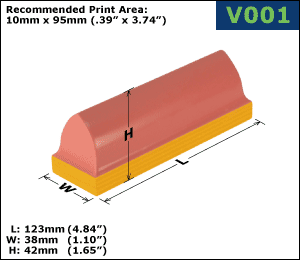
Narrow, elongated profiles for specialized linear images, tight access and applications needing a defined rolling edge.
A pad that is comfortably larger than the artwork normally deforms less as it compresses. Less deformation means less image stretch, especially near the outer edges of the print.
The practical limit is set by your machine clearance, cliché dimensions, pad holder, available compression force and surrounding fixtures.
Pad height affects how easily the silicone can flex and roll. A taller version of a similar shape may compress more progressively and can sometimes help when a large pad requires more force than the machine can comfortably provide.
Always confirm total machine clearance before increasing pad height.
Deco Tech identifies silicone pad hardness using the Shore 00 scale. Harder pads generally provide greater image stability and crisp transfer, while softer pads conform more easily to difficult geometry, fragile parts or lower-force machines.
| Base Color | Shore 00 | Relative Feel | Typical Selection Reason |
|---|---|---|---|
| Orange | 20–25 | Softest standard range | Maximum conformability when geometry or available force requires it |
| Blue | 30–35 | Soft | Complex contours, sensitive parts or lower compression capability |
| Green | 40–45 | General purpose | Common starting range balancing conformability and print stability |
| Yellow | 50–55 | Medium-firm | Common production range where additional image stability is desired |
| Red | 60–65 | Firmest standard range | Maximum stability, textured surfaces, recessed areas and applications where a firm roll is practical |
The silicone surface is the actual transfer interface. Cuts, contamination, dried ink, aggressive cleaners or excessive compression can quickly turn a correctly selected pad into a print-quality problem.
After shape, size, height and durometer are narrowed down, choose the silicone formulation and mounting arrangement that best fit the application and machine setup.
Deco Tech's flagship formulation for demanding industrial production, repeatability and long pad life.
Conductive silicone for applications where static buildup, dust attraction or ESD concerns can affect production.
A general-purpose formulation designed around quick break-in, consistent transfer and strong overall value.
A practical standard mounting option available with multiple base thicknesses and threaded insert choices. Confirm the insert style needed by your pad holder before ordering.
Useful where rigid, repeatable positioning is important, including multiple-pad arrangements. Confirm tapped-hole pattern and total machine clearance.
Before changing every variable in the process, look at how the pad is compressing. Several common print defects point directly back to pad shape, size, hardness or machine force.
| Symptom | Likely Pad-Related Cause | What to Try |
|---|---|---|
| Incomplete or irregular ink pickup | Air is being trapped between the pad and cliché because the pad is not rolling outward cleanly. | Try a steeper profile, reposition the apex relative to the image, or compare a different shape. |
| Image distortion near the edges | The pad may be too small or is being over-compressed. | Use a larger practical pad and reduce pad force to the minimum needed for complete transfer. |
| Pad will not fully conform to the part | The pad may be too firm, too short or the machine may not have enough compression capability. | Compare a softer durometer, taller profile or custom / dual-durometer solution. |
| Print sits next to a raised feature or inside a recess | A soft pad may deform into the obstruction instead of rolling over it cleanly. | Compare a firmer pad or a custom pad with geometry designed around the obstruction. |
| Pad surface wears or cuts prematurely | Excessive stroke, sharp fixture edges, empty fixture cycling, contamination or improper cleaning. | Reduce stroke/force, inspect the fixture and part, and use pad cleaning tape rather than aggressive cleaning methods. |
| Dust or static affects fine-detail printing | Static buildup can attract contamination to the print zone. | Evaluate Stat-X™ anti-static silicone and review the complete production environment. |
Record artwork width and height, print location, part geometry and any raised or recessed areas near the image.
Confirm available pad clearance, maximum practical compression, cliché size, holder arrangement and nearby fixtures.
Choose a shape that will roll through the complete image and use the largest practical pad that fits the press.
Start with a practical Shore 00 range, print samples, inspect distortion and pickup, then adjust only what the result indicates.
Use artwork size and part geometry to narrow the Deco Tech catalog, or send the application to our team when the job requires additional review, custom geometry or production testing.
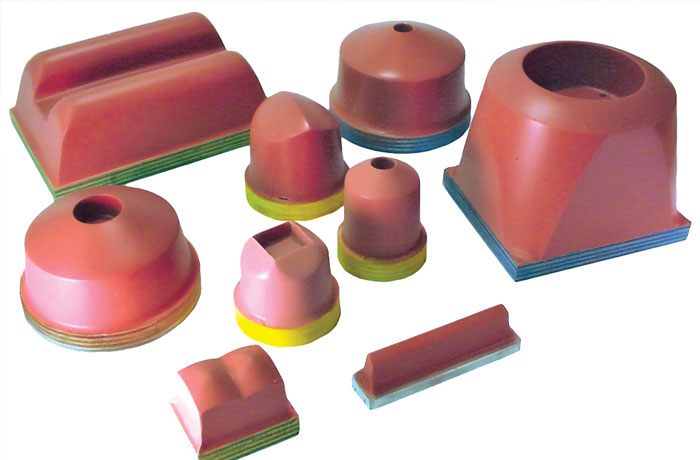
One of the most frequently asked questions in the early stages of learning the do's and don'ts of the pad printing process is, "How do I know what pad to use for this part?"
The shape of the pad directly influences the quality of the print, particularly on irregular or complex surfaces. Selecting the proper pad shape ensures even ink transfer and reduces the risk of distortion. Common pad shapes include:
The hardness of a pad, measured in Shore A, determines its flexibility and ability to adapt to the substrate’s surface.
The substrate’s material plays a crucial role in determining the type of pad needed. Certain materials, such as plastics, metals, or glass, may require specific pad characteristics for better adhesion and transfer.
Different inks behave uniquely during the printing process. Choosing a pad compatible with your ink type—whether UV, solvent-based, or water-based—is essential for achieving high-quality results.
At Deco Technology Group, we offer a comprehensive range of silicone printing pads designed to meet the demands of various industries and applications. With decades of expertise, we provide: